Bio
Augustus Jenkins Jr is a New Orleans artist, printmaker, and art educator, whose earliest memories of creating art go back to when he was four years old seating on the floor drawing comics with his older cousin. His journey in art has allowed him to come under the tutelage of artists such as Richard C. Thomas, John T. Scott, Ron Bechet, and Najjar Abdul-Musawwir as well as several others. Augustus’ time spent as a student of both Scott and Bechet in the Department of Art at Xavier University of Louisiana had a profound impact on his growth as a student of art and allowed him to receive an internship at General Motors where he was a sculpture intern in its summer design internship program. Augustus also was able to receive a scholarship to participate in a color intaglio printmaking workshop at the Anderson Ranch Arts Center in Snowmass Village, CO led by artist and master printmaker Art Werger.
After receiving his B.A. in Art from Xavier, Augustus went on to complete his MFA at Southern Illinois University Carbondale. His work has been exhibited at multiple venues throughout the New Orleans Metropolitan area from Xavier University of Louisiana, Ogden Museum of Southern Art, Ashé Powerhouse, and Stella Jones Gallery as well as at the Louisiana Art and Science Museum in Baton Rouge, LA. In the fall of 2025 he completed a week-long assistantship at the Penland School of Craft in Bakersville, NC where he served as the studio assistant to artist and master printer Steve A. Prince.
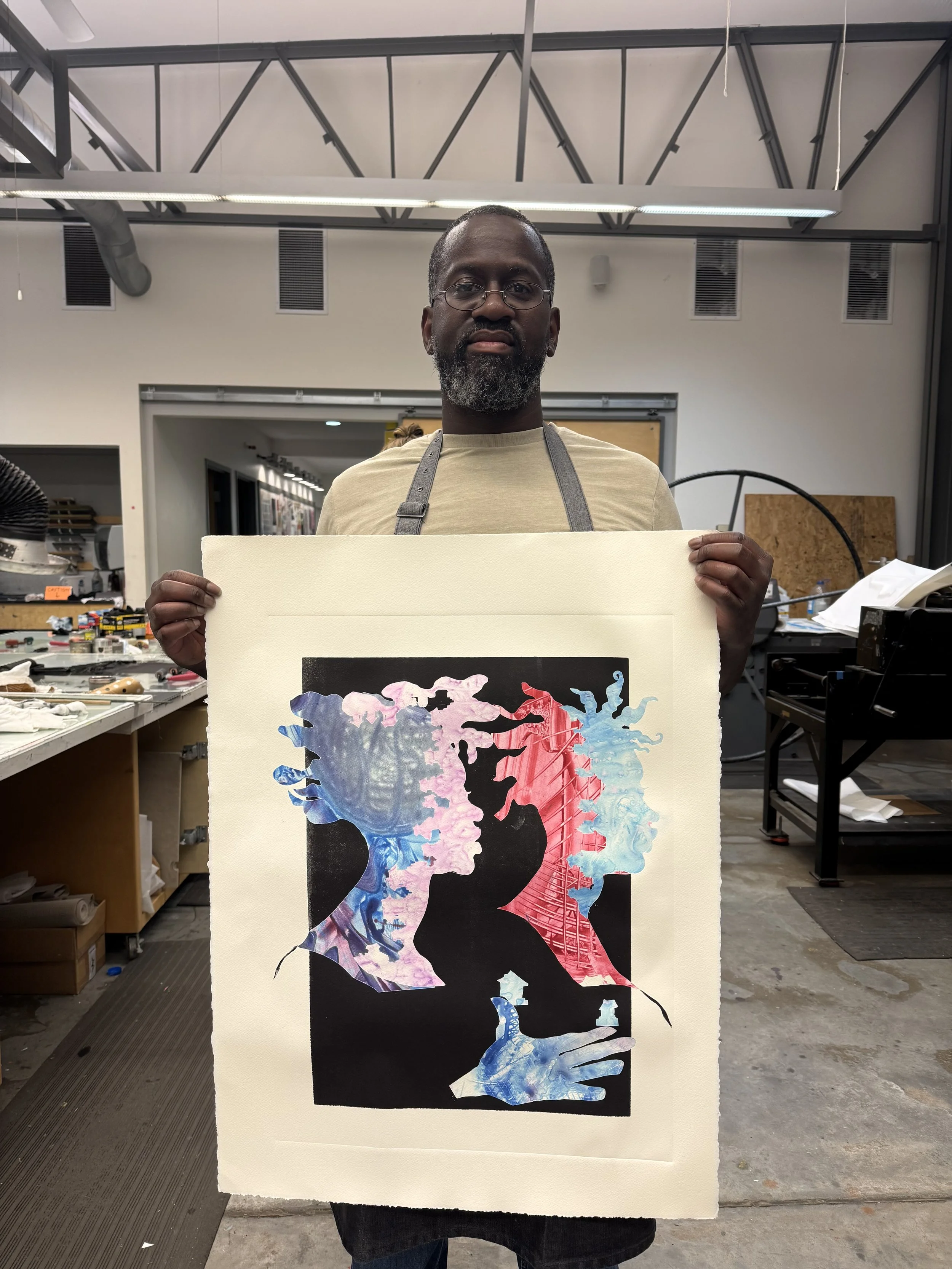
Artist’s Statement
What drives my work is the hope to respectfully visually interpret and preserve narratives, histories, and experiences that were initially passed on to me in the form of stories that I heard and learned about over the years growing up in New Orleans, LA. In these narratives, the lives of everyday people’s unsung contributions were essential to the growth, sustainability, and culture of the community and were shared, remembered, and passed on to younger generations to teach life lessons and community histories. In this context, southern architectural features such as the porch became more than just a place to cool off on humid days and nights; it became an early classroom where these lessons were instilled, and a portal to the world beyond family and community.
Over the years, as I listened to these stories and experiences from family members and people from my community, I found myself becoming very interested not just in the power of storytelling, but how I could retell and reinterpret these stories and experiences visually. Interpretation and preservation of these narratives and experiences has especially become important to me as I have matured, and realize that we are constantly losing generations of elders and their stories. I find myself wondering as I create my work if no one is left to tell their stories, what will happen to them? Also, I find myself grappling with the thought of who am I to be angry about the lack of representation of my community or how it is represented when it is; if I am not using my work as a catalyst to address such issues.